


Wedding catering cost in the UK varies widely – usually between £40 and £160 per guest – depending on service style, guest numbers and extras, with per-head pricing only covering part of the total. Understanding hidden fees and package inclusions is key to building a realistic budget.
The happiest day of your life and quite possibly the most expensive too, weddings are full of moving parts that take an unexpected amount of planning, labour… and the part nobody likes to talk about, budgeting.
According to the 2026 Wedding Industry Report, the average British wedding sits at £21,990 for the full shebang (that’s £272 per guest), but how do wedding catering costs factor into that total?
If, like many other newly betrotheds, you want every element – from canapés to silverware – to coordinate for absolute magic, but you’re worried about how much it will eat into your final spend, you’re not alone.
On the contrary, it’s one of the most common concerns that crops up among our clients – hence why I’ve pulled together this complete guide. In it, I’ll be sharing a full breakdown of the typical catering cost for a wedding, the dining options at your disposal, along with some hidden fees to watch out for.
Contents:
- TL;DR
- Overview: UK Wedding Catering Cost Benchmarks
- Why Invest in Quality Catering?
- What Drives Cost Variation? Price Factors You Need to Know
- Service Styles & Their Impact on Catering Cost
- Hidden Extras to Budget For
- Top Tips for Booking Your Catering
- Conclusion
- FAQs
TL;DR
Wedding catering cost in the UK varies widely – usually between £40 and £160 per guest – depending on service style, guest numbers and extras, with per-head pricing only covering part of the total. Understanding hidden fees and package inclusions is key to building a realistic budget.
Overview: UK Wedding Catering Cost Benchmarks
While, yes, no two weddings are the same – and nor would we want them to be – recent data from The UK Wedding Report 2026, courtesy of Bridebook, provides us with some useful benchmarks. Crunching the numbers from 7000+ UK couples, they reveal that…
- The median wedding catering cost across all options was £117 per head.
- The median for in-house catering sits at £114 per head.
- The median for external catering on a required list provided by the venue was £159 per head.
- The median for external catering freely chosen by the newlyweds is the lowest at £112 per head.
Combined venue and catering spend per head, courtesy of the UK Wedding Report 2026
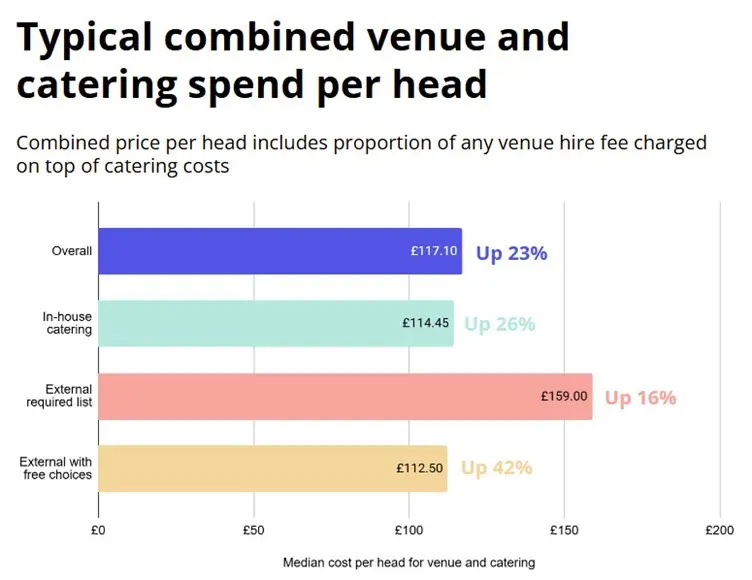
Looking at the figures above alone, it’s easy to see why catering is one of the largest wedding expenses, particularly when we contemplate the impact of predicted food inflation (an expected 9% by the end of the year). However, because of a handful of cost drivers I’ll dive into later, you mustn’t take them as cut and dried. These are benchmarks after all, not definitive figures.
Your rough total ranges will strongly depend on the number of invites (read: hungry mouths to feed) and the service style you opt for. For a 100-guest wedding, catering alone can range from £4,000 to £7,500, depending on the service style on the big day.
Pared-back catering – perhaps a single sit-down meal and drinks, or a buffet – will sit on the lower end of the scale, whilst something more tailored, intimate or, indeed, grandiose requires a much larger budget. Needless to say, there are options available at every price point:
- Affordable: £20 – £40 per head
- Moderate: £40 – £60 per head
- Premium: £60 – £80 per head
- Deluxe: £80+ per head
Whether you opt for economical or high-end is up to you; the important thing is to understand the caveats.

Service Styles & Their Impact on Catering Cost
Speaking of caveats, each style of service has its own influence on your final wedding catering cost, not to mention how smoothly the on-the-day operations flow, along with the wine. Here, the dining setup shapes the atmosphere of the event, but you’ll also see an impact on staffing levels and preparation time.
Here’s how the most common options compare.
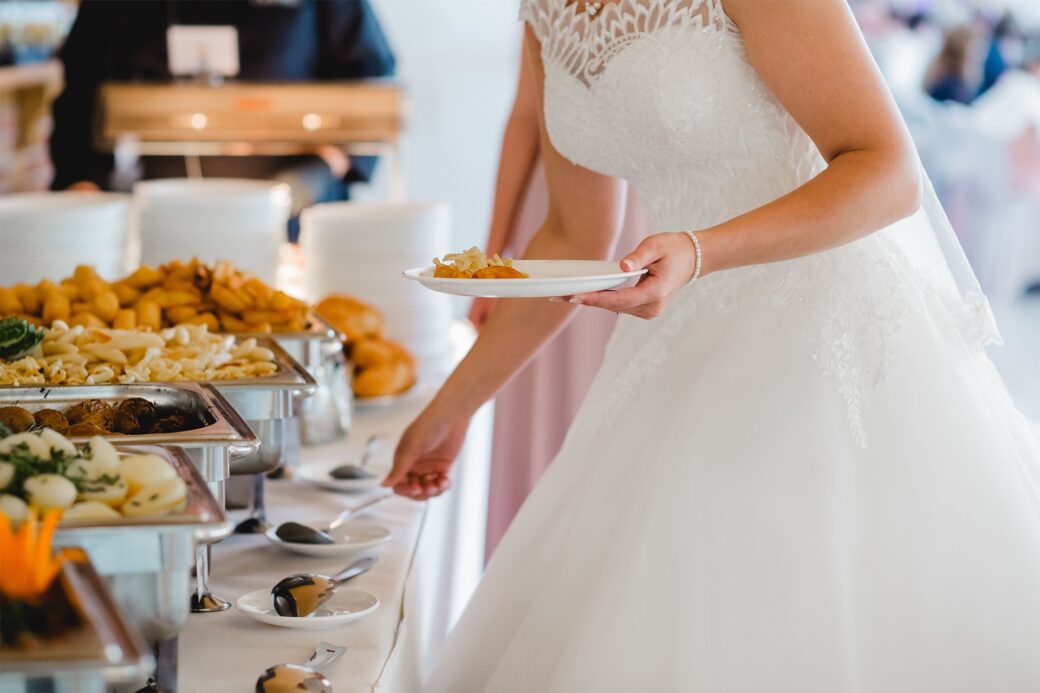
Buffet Catering
An oldie but a goodie, buffet-style catering is often the most cost-effective option and a popular choice for relaxed or informal weddings. For the ballpark of £20-30 per head, your guests can feast on a mixed array of dishes and finger foods, while you, the newlyweds, save cash on lower staffing requirements.
The downside, though, is that buffets can require more food overall to ensure availability throughout service, meaning that you need to get your estimates spot on. And if the partying is going down in a prestigious venue space, like our Parade Ring right in the heart of York Racecourse, the presentation can dampen the ambience.
Plated (Sit-Down) Dining
For a more traditional, formal experience, plated service remains the gold standard. Multiple courses served directly to the table in a structured, coordinated service, the higher number of staff involved keeps the function running like clockwork.
As you might imagine, this option tends to sit in the mid-to-premium range due to the logistics involved, but it delivers a polished, seamless experience that many couples prioritise. Case in point: Paul and Duncan celebrate their love at York Racecourse with a mouthwatering, home-cooked three-course meal.
Food Stations & Sharing Style
A growing trend across the UK, and the more refined sibling of the buffet table, food stations allow guests to mingle whilst customising their meals. Here, the setup is simple yet elegant: themed stations or share platters at the table lie in wait for hungry family and friends, doubling as interactive entertainment as well as party fuel. You can even get experimental with it – I’ve seen retro popcorn stations, sushi bars, charcuterie carts and even oyster buckets on display. Truly, the gastronomic possibilities are endless!
Costs vary depending on the complexity of the stations and menu design, but it’s often a happy medium between a traditional wedding breakfast and an informal buffet.
Premium / Bespoke Catering
For those looking to create something truly unforgettable, bespoke catering offers full customisation – of menus, ingredients, presentation and the serving experience as a whole. Imagine the Master Chef experience tailored to your love story; this is possible with the right brief in the right hands.
With little extras such as canapés, wine pairings, or late-night food, bespoke catering is where couples go all out. Unsurprisingly, this sits at the top end of the pricing spectrum, but for many, the experience justifies the investment.
What Drives Cost Variation? Price Factors You Need to Know
Even within the same service style, prices can vary significantly. Understanding what drives those differences will help you make informed decisions and avoid surprises later down the line.
- Guest numbers: The most obvious factor. More guests mean more food, more staff, and higher overall costs, although some caterers offer slight economies of scale at larger numbers (menu depending).
- Menu complexity: A simple two-course meal will cost considerably less than a six-course tasting menu with premium or specialist ingredients. Likewise, locally sourced produce can pull your budget up or down.
- Staffing requirements: Don’t forget, catering is the full dining experience, not simply sourcing the food. As such, higher numbers of bar staff, chefs and waiters naturally correlate with a higher overall spend.
- Time of year: Timing your wedding around the off-season (November to March, excluding December) can keep your budget looking trimmer, owing to the lower demand.
Hidden Extras to Budget For
This is where a lot of budgets begin to stretch, although many prospective brides and grooms might not be aware of it. Indeed, as I’ve established, the “price per head” gives you a useful starting point, but it rarely tells the full story.
To account for some of the following extra fees, I recommend leaving an additional 10–20% contingency on top of your initial catering quote.
- Corkage fees: These are charged per bottle if you bring your own alcohol
- Service charges: This will come at a percentage of the total bill
- Equipment hire: To account for crockery, cutlery, glassware, linens and any other tablescape materials.
- Additional staffing: Especially for longer events, huge guest lists or service that carries on into the evening.
- Dietary requirements: Specialist meals, for instance, locally or sustainably sourced ingredients, can carry special surcharges.
- Travel and setup costs: If your venue is particularly remote or your catering company has to travel a long distance, expect it to rack up the cost.

Why Invest in Quality Catering?
Food prices have jumped by over 30% since 2020, and couples are understandably feeling the squeeze. It’s no surprise that many are looking for ways to reduce that looming cost. Still, as far as catering is concerned, cutting corners can be a false economy; the cheapest option rarely delivers the experience you’re hoping for.
In reality, you tend to get what you pay for: lower-cost catering often means simpler menus, cold, finger food, limited service, and less attention to detail. Experienced caterers, on the other hand, offer far more than beautifully presented, delicious food. I’m talking about proper coordination, table service and reliability: courses served on time and meals arriving piping hot.
It’s this level of professionalism, often unnoticed when done well, that will help sculpt the lasting memories that you’ll look back on with fondness.
What Can I Do With a Lower Budget?
Catering matters, but two things can be true at once. In this case, I mean that it’s possible to tick the box of both budget-friendliness and create the perfect experience for those you love most in the world.
For a start, you might want to source catering outside of the venue, if the space permits. Here, hiring a food van or local catering company – even from a college or school around the corner – brings a unique, even quirky touch at a lower price point. Likewise, opting for drinks on arrival and a couple of bottles for each table will help you side-step the eyewatering cost of an open bar.
But if you’re both foodies, and top-tier catering is non-negotiable, this is when you should consider scaling down other areas. Before you panic, though, I’m not going to tell you to ruthlessly uninvite all the plus ones and pick a more compact conference room layout within the venue. No, what I will suggest is DIYing things where they hit home the hardest: in your decorations, band, wedding favours and entertainment. You might find that it enhances, not hampers, the experience.
Top Tips for Booking Your Catering
With so many moving parts, a little preparation goes a long way. Here are some practical tips to help you stay in control of your budget and expectations.
- Plan well in advance: Many caterers book out a year in advance, so in this case, the early bird really catches the worm. Speaking of, keep on the lookout for early bird offers.
- Ask for fully itemised quotes: This will ensure you understand exactly what is and isn’t included on the bill, eliminating any nasty surprises.
- Confirm staffing levels: I don’t even want to dwell on the worst-case scenario that an understaffed reception would be, but it has to be done. Make sure that adequate helping hands are there for the celebrations, so everything runs smoothly.
- Schedule a tasting: This is a crucial (and delicious!) step in assessing quality and presentation prior to the momentous day.
- Clarify minimum guest numbers or spend: Some caterers require a baseline commitment; for instance, at York Racecourse, we ask for a minimum attendance of 75 guests.
- Check flexibility: Can menus be adapted? Are packages customisable? If not, does this pose a problem?
- Read reviews and testimonials: While food quality might be your initial focus, remember to look for the intangible stuff too – consistency in service, proper etiquette, attentiveness and attention to detail all go a long way.
Conclusion: Find the Happy Medium for the Happy Couple
Like many other wedding planning elements, navigating the catering is all about balance.
While it’s tempting to focus purely on the price tag, the real value lies in the experience you create – one wherein all of the months of preparation fade into the background as you make the most joyful memories of your life with your people. From relaxed buffets to fully bespoke dining, there’s no one-size-fits-all approach, only what works best for your vision and your budget.
By understanding the typical wedding catering cost, what’s included, and where additional charges can arise, you’ll be in a far stronger position to make confident, informed decisions.
And if transparency, flexibility, and attention to detail are high on your list, it’s worth exploring venues and catering teams that prioritise exactly that. Here, at York Racecourse, we fit the bill, providing refined service and proper venues in true Yorkshire style. Intrigued? Then get in touch.
Frequently Asked Questions
What is the Average Wedding Catering Cost Per Head in the UK?
Most couples can expect to pay between £40 and £160 per guest, depending on the service style, menu, and level of service provided.
What Do Catering Charges for Weddings Usually Include?
Typically, this covers food preparation, service staff, and sometimes basic tableware; though extras like drinks, linens, and equipment hire may be charged separately.
Is Buffet Catering Cheaper than Plated Service?
In most cases, yes. Buffets require fewer staff and less coordination – hence why they’re a more budget-friendly option.
What Hidden Costs Should I Expect with Wedding Catering?
Common extras include corkage fees, service charges, equipment hire, and dietary requirements, all of which can add significantly to your final bill.
How Can I Reduce My Wedding Catering Cost?
Consider simplifying your menu, reducing guest numbers, choosing seasonal ingredients, or opting for a less formal service style. You may also wish to forgo an open bar for set drinks as part of a plated service.
